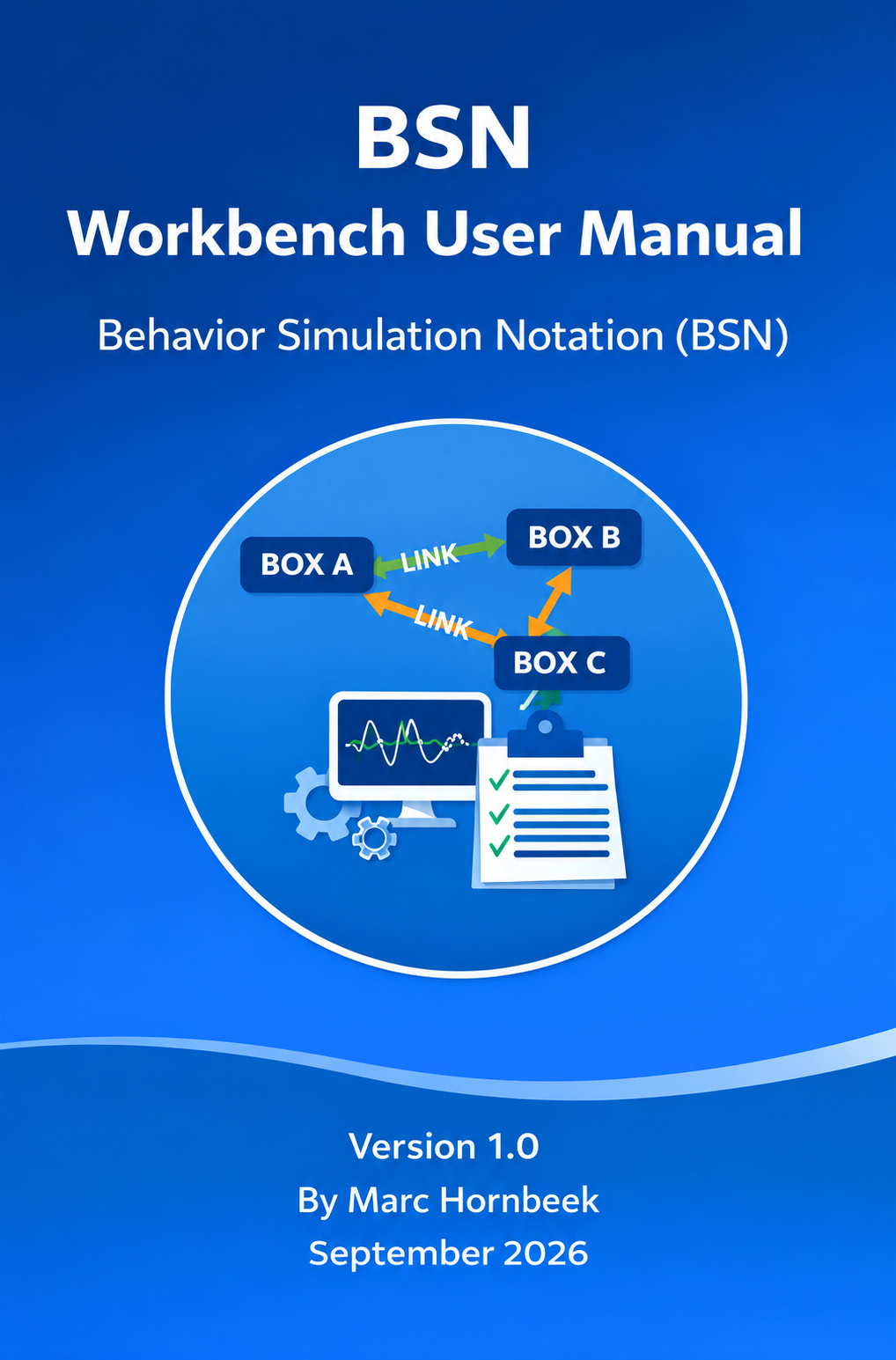
BSN Workbench User Manual

$9.95

This manual serves two related purposes. It introduces the reasoning behind Behavior Simulation Notation, and it provides a practical reference for creating, validating, and running models in the BSN Workbench. BSN and the BSN Workbench are designed to be used together with the book Simulation-Driven Software Engineering: A Behavior-First Discipline for Modern Systems. The book explains the broader Behavior-first engineering discipline, BSN expresses the required Behavioral model, and the Workbench validates that model through simulation. New users should begin with Getting Started and the worked login example. Readers who already understand the approach can use Chapters 3 through 12 as a language and Workbench reference.

For further information and articles about SDSE, refer to the Resources page at PrimaModus.com.

The central idea is simple: describe the Behavior that a system must exhibit, run that description as a simulation, and resolve ambiguity before implementation makes change expensive. The model becomes a shared reference for design discussions, test planning, security analysis, and later implementation work.

Behavior Simulation Notation (BSN) and the BSN Workbench were created to address a persistent problem in software engineering: the late discovery of Behavioral defects.

Traditional approaches defer validation of system Behavior until after implementation. This results in ambiguity, rework, defects, and operational failures discovered too late.

BSN introduces a Behavior-first discipline: system Behavior is defined, simulated, and validated before any implementation begins. The result is earlier defect discovery, cleaner architecture, and a shared Behavioral contract across all stakeholders.


Category: Tags: , Brand:

Description

This manual serves two related purposes. It introduces the reasoning behind Behavior Simulation Notation, and it provides a practical reference for creating, validating, and running models in the BSN Workbench. BSN and the BSN Workbench are designed to be used together with the book Simulation-Driven Software Engineering: A Behavior-First Discipline for Modern Systems. The book explains the broader Behavior-first engineering discipline, BSN expresses the required Behavioral model, and the Workbench validates that model through simulation. New users should begin with Getting Started and the worked login example. Readers who already understand the approach can use Chapters 3 through 12 as a language and Workbench reference.

For further information and articles about SDSE, refer to the Resources page at PrimaModus.com.

The central idea is simple: describe the Behavior that a system must exhibit, run that description as a simulation, and resolve ambiguity before implementation makes change expensive. The model becomes a shared reference for design discussions, test planning, security analysis, and later implementation work.

Behavior Simulation Notation (BSN) and the BSN Workbench were created to address a persistent problem in software engineering: the late discovery of Behavioral defects.

Traditional approaches defer validation of system Behavior until after implementation. This results in ambiguity, rework, defects, and operational failures discovered too late.

BSN introduces a Behavior-first discipline: system Behavior is defined, simulated, and validated before any implementation begins. The result is earlier defect discovery, cleaner architecture, and a shared Behavioral contract across all stakeholders.