Description
 Software engineering has always been an exercise in managing complexity. Over the decades, we have developed better tools, improved processes, and refined practices to help us build increasingly sophisticated systems. Yet despite this progress, one problem has remained stubbornly persistent: we often do not fully understand how our systems will behave until after we build them. This is not a failure of effort or intent. It is a structural limitation of how software engineering is commonly practiced.
Over time, however, the broader software industry moved in a different direction. Agile and DevOps practices have significantly improved speed, collaboration, and feedback, enabling teams to detect and respond to issues earlier than ever before. However, even with these advances, most organizations still rely on implementation as the primary mechanism for discovering system behavior. SDSE builds on these practices by shifting a portion of that discovery earlier, before implementation begins. discovered through implementation and testing rather than defined and validated beforehand.
The emergence of AI-assisted development makes this gap more significant. We can now generate code faster than ever before. Entire components can be created in seconds. But speed does not guarantee correctness. In fact, it increases the risk that systems will be built on misunderstanding or incomplete behavior. Without a disciplined approach to validation, we risk accelerating the creation of systems that are difficult to understand, control, and trust.
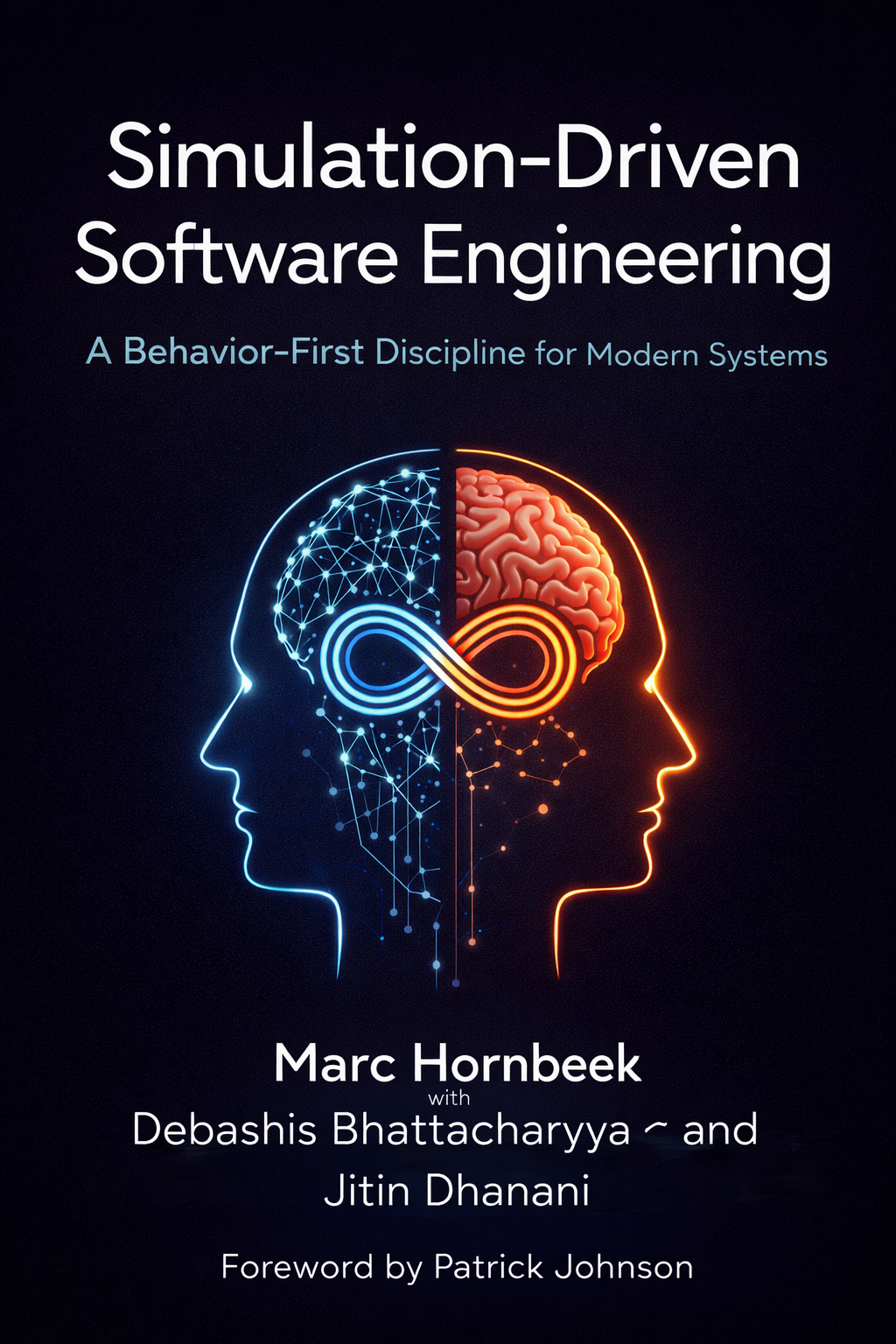
This book introduces Simulation-Driven Software Engineering (SDSE) as a response to this challenge. SDSE is not a new tool or a single technique. It is a shift in perspective. It places system behavior at the center of the engineering process and uses simulation to define, explore, and validate that behavior before implementation begins. It treats simulation as an executable specification and a living asset that evolves with the system. It aligns implementation, testing, and operations around a shared, validated understanding of how the system is supposed to behave.
This book is also the result of collaboration. I chose to include Deb and Jitin as co-authors because we have worked together on real-world projects where the principles and practices described in this book were not theoretical. They were applied under real constraints, with real systems, and with measurable outcomes. In those engagements, we saw firsthand how defining and validating behavior through simulation transformed the engineering process. It reduced ambiguity, exposed issues early, and enabled teams to deliver systems with greater confidence and predictability.
Their contributions reflect practical experience, not abstract theory. They bring perspectives shaped by hands-on application, and their insights strengthen the ideas presented in this book. Simulation-Driven Software Engineering is not the product of a single viewpoint. It is the result of shared experience and collective learning.
The ideas in this book are grounded in both historical practice and modern necessity. The principles of early validation, modeling, and simulation have long been used in other engineering disciplines and in high-reliability software domains. What has changed is the context. The scale, complexity, and speed of modern software development now make these principles essential rather than optional.
This book is written for engineers, architects, and leaders who want to build systems that are not only functional, but predictable and trustworthy. It is for those who recognize that speed without control is not progress, and that true engineering requires more than assembling code. It requires defining and validating behavior with discipline and intent.
Simulation-Driven Software Engineering is not an incremental improvement. It is a necessary shift. As AI accelerates the generation of software, the gap between what we build and what we understand will only widen unless we change how we engineer systems. Practices that depend on discovering behavior after implementation will not scale to this new reality.
SDSE does not eliminate specification. It makes specification correct.
The future of software engineering will not be determined by how quickly we can produce code. It will be determined by how reliably we can define, validate, and control system behavior. That is the discipline this book advocates.